

This educational research summary does not replace individual medical or nutrition advice.
Science-news source: ScienceAlert
The Vivid Dreams Stage of REM Sleep Is Linked With a Lower Risk of 83 Diseases
News publication date: September 21, 2026
News summary
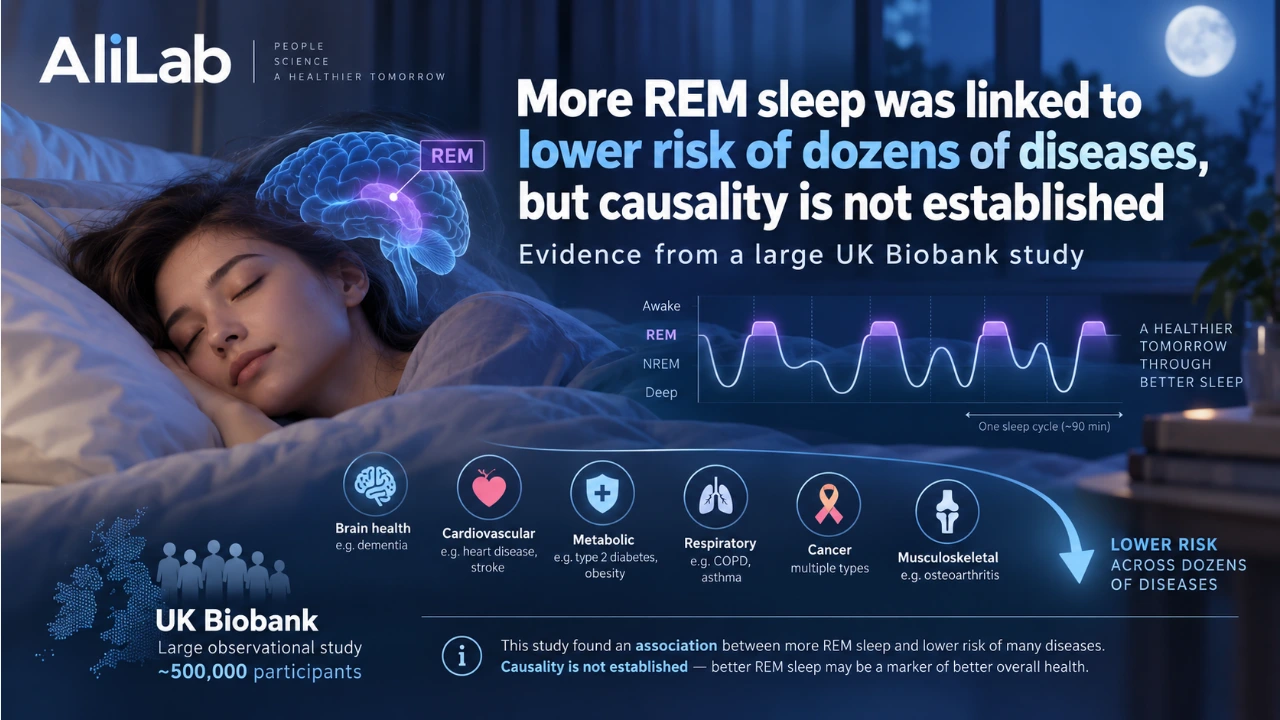
ScienceAlert highlighted a large PLOS Medicine study using wrist-accelerometer data from 95,559 UK Biobank participants. UK Biobank is a large UK research resource that follows volunteers' health data over time. Sleep stages were estimated with a deep-learning model, and participants were followed for a median of 8.9 years. Across more than a thousand health outcomes, a greater amount of REM sleep—the rapid-eye-movement stage often associated with vivid dreaming—was statistically associated with lower risk of 83 diseases.
Original research title
Accelerometer-derived real-world sleep stages and risk of incident diseases: A UK Biobank cohort study and phenome-wide association analysis
An interquartile-range increase in REM duration of about 47.6 minutes was associated with lower risk of a wide range of conditions, including heart failure, atrial fibrillation, dementias, and Alzheimer’s disease. Deep sleep was linked to lower risk of seven diseases. Sleep duration also showed nonlinear associations, with 6–8 hours corresponding to the lowest risk for many outcomes.
The findings emphasize that sleep architecture may matter alongside total sleep duration, but they do not show that deliberately increasing REM sleep by itself prevents disease. Regular sleep timing, adequate sleep opportunity, and addressing factors that disrupt sleep remain more defensible practical messages.
This was an observational study and cannot establish causation. Sleep stages were not measured nightly by polysomnography, a specialist sleep test using multiple physiological sensors; instead, they were estimated from accelerometry using SleepNet, a deep-learning model for sleep-stage estimation. Sleep was captured over a limited measurement window, residual confounding may remain, and the UK Biobank sample was predominantly White.
Discussion
Comments
Share your view on this research update.
Loading comments…